Pilot Guidance
The open calls are closed and the pilots are building. This section carries everything a pilot needs from that point on — what to build, how to build it so it connects, and what has to be delivered — alongside an archive of what the calls originally asked for.
-
Implementation guidance
What you are building, the reference architectures per work strand, and how the methodology, technical resources and Blueprint fit together.
-
Workflows
Three worked recipes — interconnect existing LDTs, deploy a new one, build an AI service — step by step, naming the tools at each stage.
-
Pilot obligations
What must be built, assessed, documented and published, with the Rq and Rc codes and which strands each applies to.
-
Posting updates & contributing
How to publish your pilot's progress, ask questions, compare approaches, and suggest additions to the Knowledge Base.
-
Open calls (archive)
Consortium conditions, financial rules, timelines and the Call for Pilots Manuals, kept as a record now the calls have closed.
Start from where you are
Start with the implementation guidance to place yourself — which LDT level you are working at, which reference architecture applies, and how the methodology, resources and Blueprint connect.
Then follow the workflow for your work strand:
| Your situation | Workflow |
|---|---|
| Existing twins that need to talk to each other | WS1 · Interconnect existing LDTs |
| A twin that does not exist yet | WS2 · Deploy a new LDT |
| A working twin that should predict, explain or advise | WS3 · Build an AI-based service |
Keep the obligations page open alongside — several steps carry binding requirements.
As you go, post updates on what you build and learn. They appear on your pilot's page and in the updates feed.
The obligations page groups requirements by theme — build, interoperate, follow the methodology, engage, share back, sustain — with the Rq/Rc codes and a column per work strand.
Codes differ between strands, so read your own column. For binding wording, go to the Call for Pilots Manual.
The two deadlines most often missed:
- the ISAQ in months 1–2 and again in the second reporting period — a final score above three is a condition for payment;
- packaging and publishing assets, which is far cheaper done continuously than at the end.
The calls are closed, but the full reference is archived: open calls for consortium conditions, financial rules and timelines, and the per-strand cheat sheets for the detailed breakdowns — WS1 · WS2 · WS3.
The three work strands
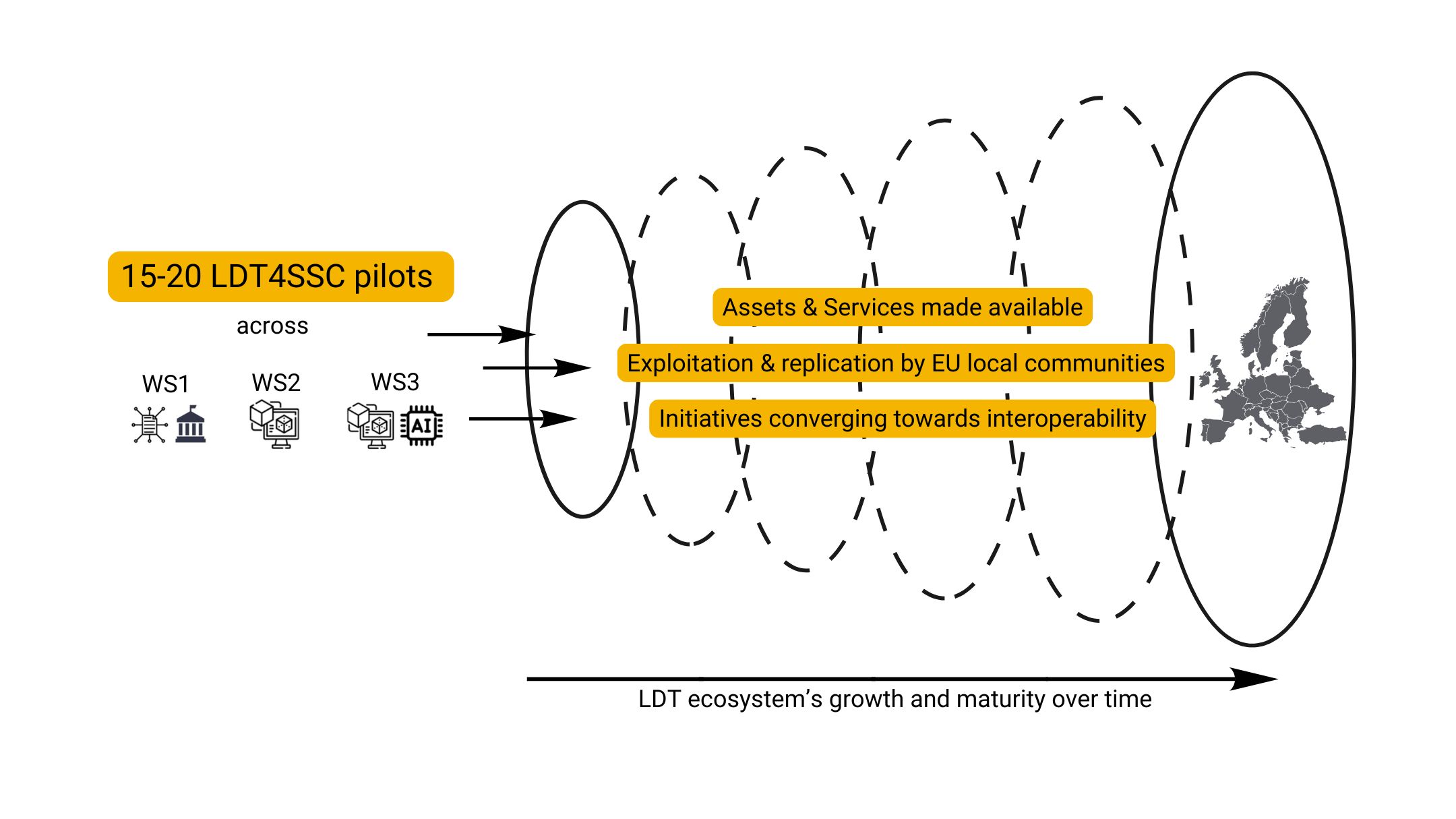
Each strand targets a different level of the LDT stack. They stack on one another — a WS3 service still needs the Core a WS2 pilot builds.
WS1 · Technical interconnection of LDTs
Linking and scaling digital twins already in place. Works at the Base and Core levels: exposing what exists through standard interfaces and connecting it to other twins.
WS2 · Creation of LDTs based on common needs
Addressing shared urban or regional challenges. Builds the Core: shared data acquisition, context management and analytics, specified once and instantiated locally.
WS3 · Advanced AI-based capabilities
Integrating AI-driven services into existing LDTs. Works at the Surface: AI services, simulation and immersive interfaces consuming an existing LDT and publishing results back into it.
Testing environment
A sandboxed reference environment for pilot demonstrations is planned, so that pilots can try a deployment without standing up their own stack first.
Coming soon
The environment is not yet available. In the meantime the technical resources list the components to deploy locally.
Related sections
-
Resources
The technical resource library, the LDT4SSC Methodology and its workshops, impact assessment, legal and AI guidance.
-
Interoperability Blueprint
Building blocks, workflows and reference architectures — co-created with pilots and under active development.
-
Strategy & Sustainability
The conditions these obligations are designed to create, and 18 capabilities mapped against the same requirement codes.
-
Pilot Journey
What the pilots are building, the obstacles they hit, and the assets they publish.