Non-technical Resources
On this page
- Example Stories - See potential pilot scenarios
- The LDT4SSC Methodology - Four-phase implementation framework
- The LDT4SSC Impact Assessment Framework - Structured monitoring and evaluation
- Cost-Benefit Analysis - CBA tools and guidance
- Legal Guidance - Practical legal guide for LDT projects
- Guidance on AI - Guidance specific for AI-based services
- Other Resources - Additional ecosystem resources
What you'll find here
These non-technical resources provide practical guidance for the organisational, strategic, legal, and governance aspects of the pilot journey. The resources support pilots and applicants in aligning stakeholders, structuring responsibilities, anticipating risks, and creating the conditions for sustainable, interoperable, and widely adopted digital services. Together, these methods and workshops help build the shared culture, clarity, and coordination required to transform a use case into a long-lasting, impactful solution.
New to the project? Start here.
- Read the Work Strands Overview below to identify which strand fits your project.
- Browse the Example Stories to see how pilots like yours could look.
- Use the Methodology to get an overview of the four phases.
- Dive into the phase most relevant to where you are in your journey.
Work Strands Overview
The non-technical resources support pilots across three interconnected work strands, each requiring different organisational approaches:
WS1: Technical Interconnection of LDTs
Linking and scaling digital twins that are already in place
Focus on multi-stakeholder governance, legal frameworks for data sharing, cross-organisational coordination, and partnership models for federated LDT ecosystems.
WS2: Creation of LDTs Based on Common Needs
Addressing shared urban or regional challenges (e.g., cross-border traffic, air pollution)
Emphasis on use case co-creation, stakeholder alignment, data governance frameworks, business model design, and responsible digital principles for new LDT initiatives.
WS3: Adding New Advanced AI-Based Tools to existing LDTs
Integrating AI-driven, value-added services to enhance existing LDTs and new services to the LDTs Toolbox
Focus on change management, user training and adoption, ethical AI considerations, and preparing organisations for advanced analytics and decision-support capabilities.
Example stories
To illustrate the potential of each WS, we present a set of Pilots' Example Stories, i.e. fictional scenarios that demonstrate how future pilots could emerge and operate within the LDT4SSC project framework. These examples are intended to help prospective applicants envision their own roles and opportunities within the initiative.
The example stories developed for WS1 show how cities and communities with an existing level of digital maturity (as described in the Requirements section) can build on their Local LDTs to form a federated, EU-wide ecosystem. Each example illustrates how interoperability, cross-border collaboration, and shared data platforms can enable scalable and replicable solutions. The realistic use cases highlight the concrete benefits of interconnected LDTs, such as improved decision-making, resource optimisation, and faster adoption of open-source tools, while also addressing common challenges like technical integration, governance, and stakeholder coordination. Their purpose is to inspire replication, lower entry barriers for less digitally advanced regions, and foster a shared community of practice around federated LDTs, advancing the project's goal of a unified and interoperable digital infrastructure for Europe.
Traffic Management and Air Quality
Two municipalities of similar size, population, and density have each developed a descriptive Local Digital Twin (LDT) to monitor traffic, air quality, and their interaction. They partner with a specialised private service provider to interconnect their systems and exchange data and related services using the NGSI-LD standard. By linking their context brokers, the partners establish a shared real-time dashboard that enables coordinated management of transport corridors and supports efforts to reduce congestion and pollution.
To ensure seamless data and service interoperability, the partners align their API documentation with the MIM1. The outcomes include both operational improvements such as optimised traffic flows and reduced emissions, and reusable assets such as standardised data models and dashboards that can be adopted by other cities.
This example reflects the ambition of WS1: to scale up EU-wide datasets and open-source solutions within the LDT ecosystem, demonstrating how federated approaches can transform local innovations into collective impact.
Interconnected Networks Management and Service Marketplace
Cities of a DS4SSCC Pilot projects interconnect their Local Digital Twins (LDTs) with those of another group of communities to create a shared marketplace for essential public services, aligned with the priorities of each local authority. These services may include areas such as mobility, land-use planning, and energy or electricity management, reflecting the themes of the New European Bauhaus (NEB) and the European Green Deal. By leveraging the SIMPL building blocks and the FIWARE ecosystem of technologies, this new consortium integrates waste, energy, and water management systems, enabling local authority syndicates to exchange data, optimise resource allocation, and deliver new services across regions. The main challenge lies in ensuring the maturity of the connector, which must reliably bridge diverse platforms while maintaining data consistency and security.
The outcomes include operational efficiencies such as streamlined network management and cross-city service coordination, as well as contributions to the SIMPL framework, reinforcing its role as means for interoperable LDT ecosystems. This example illustrates how federated LDTs can move beyond individual city silos, fostering a collaborative economy of shared services and scalable, cross-regional solutions.
Regional Energy and Climate Data Space
Several municipalities in a cross-border region with varying digital maturity levels create a shared DS to combine energy production and consumption data. The goal is to monitor regional energy use and evaluate its climate impact. Together with a data space specialist and a local energy supplier, the municipalities deploy a FIWARE Data Space Connector and use the EU LDT Toolbox to model scenarios on energy demand, renewable integration, and the environmental impact of alternative energy sources. The main challenge is to manage data access rights among diverse stakeholders (municipalities, regional alliances, and private partners) while ensuring secure data exchange and consistent decision-making across governance levels.
The project delivers a real-time regional overview of energy supply and demand, enabling policymakers, businesses, and citizens to track consumption patterns and make informed choices. It demonstrates how federated LDTs can consolidate fragmented local data into a unified, actionable resource for advancing climate resilience and the energy transition.
Local carbon emissions and sequestration urban platform
Facing comparable challenges and climate targets, two regions of similar size and population in two EU countries have joined forces to develop a shared LDT to monitor and manage their Scope 1 and Scope 2 carbon emissions and sequestration capacities.They partnered with an academic institution specialized in climate change science and mitigation strategies, ensuring methodological robustness and alignment with the latest research. In parallel, a private company specialized in energy grids provides real-time and historical data on electricity distribution, consumption patterns, and grid decarbonization pathways. The LDT integrates geospatial, energy, mobility, land-use, and environmental datasets into a dynamic urban model.
This enables the monitoring of direct emissions from operations and local fuel combustion (Scope 1), as well as indirect emissions linked to electricity consumption (Scope 2). A key feature of the platform is its simulation capability, allowing urban planners to assess how new infrastructure projects (e.g. roads, residential developments, or public facilities) affect overall CO₂ emissions. The system quantifies both the additional energy demand generated by new constructions and the loss of natural carbon sinks caused by land-use change. By visualizing these impacts before implementation, decision-makers can compare alternative scenarios and adopt lower-carbon solutions.
The LDT also supports a bottom-up emissions accounting approach, aggregating data from buildings, transport networks, and public assets to generate accurate and transparent inventories. Automated reporting tools simplify compliance with national and European climate frameworks. Beyond internal planning, the platform enhances communication with citizens through accessible dashboards and visual storytelling tools. Residents can better understand how local projects influence emissions and climate goals. Ultimately, the shared LDT strengthens inter-region collaboration, evidence-based policymaking, and public trust in the transition toward climate neutrality.
Climate-Resilient Urban Greening
Two European cities jointly deploy a local digital twin using the European Commission’s EU LDT Toolbox to address rising urban heat challenges. The shared objective is to mitigate increasingly unlivable summer heat driven by climate change through data-informed greening strategies.
Each city operates its own on-premise instance, ensuring data sovereignty while enabling cross-border collaboration. A specialised service provider supports integration, interoperability, and alignment with EU standards. The LDT aggregates GIS layers, CIM models, and real-time sensor data into a unified urban intelligence platform.
A dynamic heat map identifies urban heat islands across neighborhoods.By correlating temperature data with land use and surface materials, the platform highlights priority zones for intervention. The cities use the model to detect rooftops, vacant plots, schoolyards, and underused public land suitable for urban farming and tree planting.
From the outset, citizens are invited to contribute by identifying private spaces that could be vegetated, strengthening community ownership.
At project completion, both cities publish their developed assets as open source and contribute enriched smart data models back to the European ecosystem.
The LDT4SSC Methodology
The LDT4SSC Methodology is a use-case-centered four-phase implementation framework that guides LDT4SSC pilots from initial ideation through to full deployment of their projects. This methodology provides a logical implementation framework for building a Local Digital Twin by structuring the pilot journey into four steps EXPLORE (Ideation), VALIDATE (Specifications), DEFINE (Prototyping), and IMPLEMENT (Deployment), ensuring that each stage builds on validated outputs from the previous one. The methodology integrates 15 practical and self-contained workshops each tackling different challenges such as use case definition, data governance, interoperability, business modelling, and stakeholder onboarding.
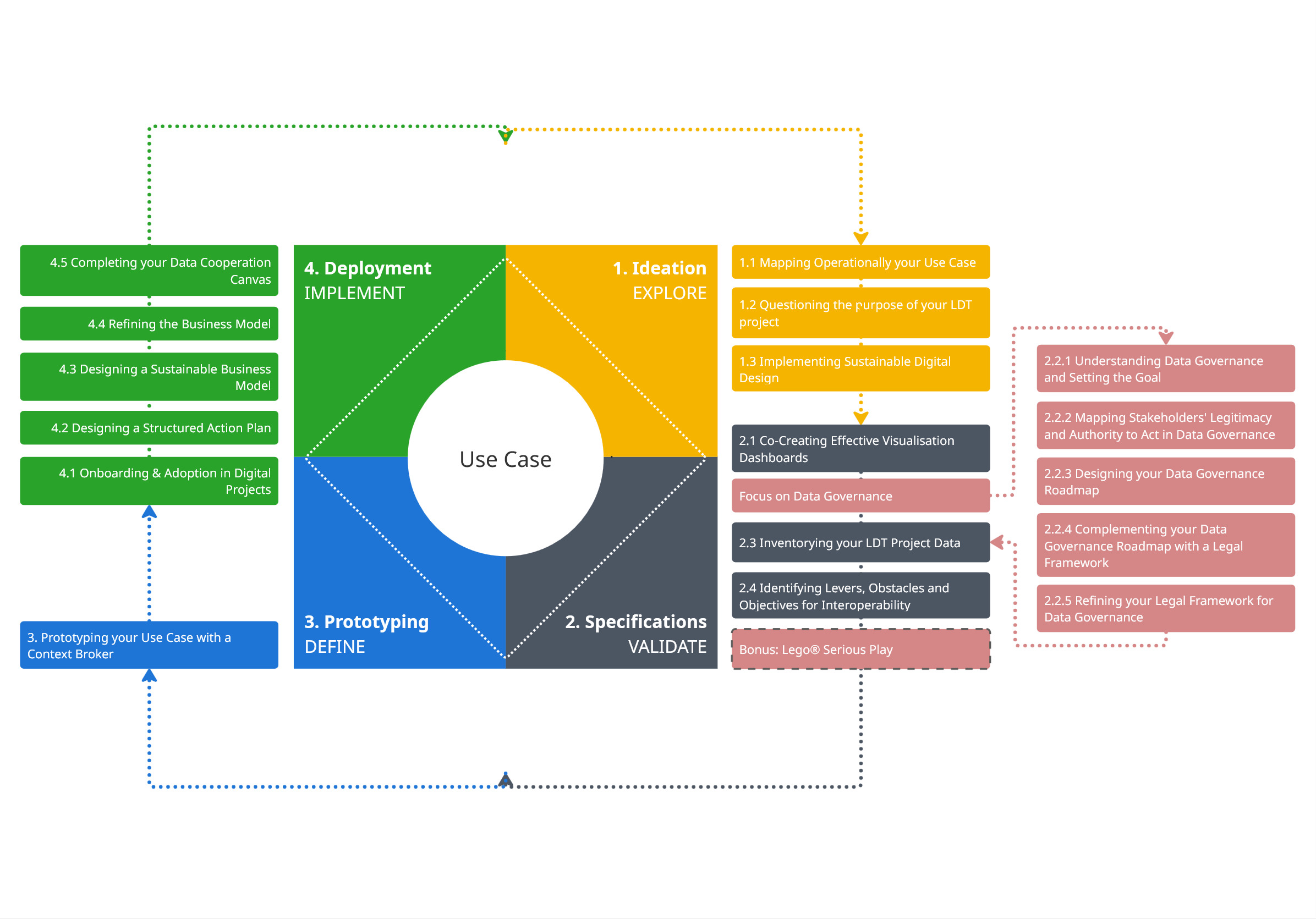
Workshop Overview
| # | Workshop | Phase | Duration |
|---|---|---|---|
| 1.1 | Mapping your Use Case | EXPLORE | 3h |
| 1.2 | Questioning The Purpose of your LDT Project | EXPLORE | 2h 40min × 3 |
| 1.3 | Implementing Sustainable Digital Design | EXPLORE | 2h |
| 2.1 | Co-Creating Effective Visualisation Dashboards | VALIDATE | 3h |
| 2.2.1 | Understanding Data Governance and Setting the Goal | VALIDATE | 2h |
| 2.2.2 | Mapping Stakeholders' Legitimacy and Authority | VALIDATE | 1h 30min |
| 2.2.3 | Designing your Data Governance Roadmap | VALIDATE | 2h 5min |
| 2.2.4 | Complementing your Data Governance Roadmap with a Legal Framework | VALIDATE | 2h 30min |
| 2.2.5 | Refining your Legal Framework for Data Governance | VALIDATE | 1h 30min – 2h |
| 2.3 | Inventorying your LDT Project Data | VALIDATE | 1h 40min |
| 2.4 | Identifying Levers, Obstacles and Objectives for Interoperability | VALIDATE | 2h |
| BONUS | Lego® Serious Play | VALIDATE | 2h 45min |
| 3.1 | Prototyping a Use Case with a Context Broker | DEFINE | — |
| 4.1 | Onboarding & Adoption in Digital Projects | IMPLEMENT | 1h 30min |
| 4.2 | Designing a Structured Action Plan | IMPLEMENT | 1h 45min |
| 4.3 | Designing a Sustainable Business Model | IMPLEMENT | 1h 50min |
| 4.4 | Refining the Business Model | IMPLEMENT | 2h 25min |
| 4.5 | Completing your Data Cooperation Canvas | IMPLEMENT | — |
The LDT4SSC Methodology
Explore the full methodology with detailed phase descriptions, prerequisites, objectives, stakeholders, and workshop resources.
The LDT4SSC Impact Assessment Framework
The LDT4SSC Impact Assessment Framework provides a structured intervention logic based on the theory-of-change to track how pilot activities translate into outputs, outcomes, and longer-term impacts within the LDT4SSC programme. It standardises monitoring across pilots, aligning pilot outputs (e.g., use cases, operational LDTs, interoperable artefacts, AI services, governance arrangements, communities of stakeholders, and value-proposition evidence) with broader changes that pilots aim to enable, linked to project-level outcomes (federation of LDTs, uptake by less-advanced communities, and service adoption) and EU-level impacts (sustainability, resilience, and alignment with the Green Deal and SDGs).
By defining clear output, outcome, and impact indicators and validation methods, the framework ensures comparability, repeatability, and a basis for aggregation and recommendations for the Common Interoperability Blueprint and LDT ecosystem.
The framework is embedded in the pilot's journey, requiring pilots to describe context and inputs, report activities and track specified output indicators, and to link outputs to measurable short-term outcomes and intended long-term impacts. Monitoring is iterative: pilots submit baseline, interim (6-monthly) and final reports through self-assessment questionnaires that will be shared later on as resources to pilots.
The LDT4SSC Impact Assessment Framework
Cost-Benefit Analysis
Cost-Benefit Analysis (CBA) is a decision-making tool that involves measuring the various expected effects of a public policy, relative to a baseline situation, by expressing them in a common unit — the monetary unit. These effects can be:
- Economic: savings for the community, investment costs, gain or loss of productivity.
- Social: changes in quality of life, noise pollution, etc.
- Environmental: evolution of pollution, impact on biodiversity, CO2 emissions, etc.
Public investment is justified if the digital solution produces more benefits than completing the project without this solution.
In the context of the LDT4SSC project, pilots must perform a cost-benefit analysis of their projects and share it as part of Pilot Deliverable 5. The purpose of this evaluation is to allow for a comprehensive assessment of the digital solution and to deduce its financial as well as socio-environmental utility. This evaluation can be done after the solution has been implemented (ideally one year after), but also — with less accurate results — before implementation. It is recommended that pilots record the relevant baseline data before they start their project to be able to carry out the comparison.
Pilots will find below a document to guide them in evaluating the actual costs and objective benefits for the different beneficiaries of their pilot projects.
Cost-Benefit Analysis - Guidance Document
More information:
Legal Guidance
To go beyond purely regulatory aspects and guide public authorities and their service providers in setting up a legal framework for their projects and navigating the legal journey, a Practical Legal Guide will be shared below.
This document provides legal guidance at all steps of a typical project lifecycle, mirroring the operational and technical steps of the LDT4SSC Methodology. These legal stages complement the project-level steps of the methodology: (1) Explore – Ideation, (2) Validate – Specification, (3) Define – Prototype, and (4) Implement – Deployment. Project legal milestones — such as implementing a call for tenders, partnering up, setting proper data governance, the end of a legal contract, or mutualising a platform — are typical legal stages of a project. The guide prompts project managers with the relevant questions at every stage, providing recommendations and resources to help them find fit-for-purpose legal clarity.
This guidance can be applied to most projects adapting, testing, or creating platforms involving innovative technologies such as LDTs, and that require a public authority to provide domain expertise, know-how, and/or share data originating from the operation of their public services.
After implementation and completion of the project, having followed these guidelines enables cities and communities to:
- Open their platform to other local authorities to share costs.
- Connect their platform to third parties.
- Have their platform maintained by an entity other than the initial contract holder.
- Have their platform commercially exploited by a private entity to sustain it, without appropriation.
The LDT4SSC Practical Legal Guide
PDF coming soon — contact the project team in the meantime.
Guidance on AI
This page provides non-technical guidance specific to WS3 pilots deploying LDTs with AI-based capabilities. It covers:
- Regulatory compliance — the AI Act, its risk-based approach, the Digital Omnibus amendments, and recommendations for compliance
- Environmental impact — the ITU-T L.1801 lifecycle assessment framework and tools to measure AI energy consumption
- Ethics — the LDT4SSC ethics framework, and key considerations around bias, explainability, end-user rights, human oversight, and societal impact
Guidance on AI
Other Resources
| Author / Title | Description and use for pilots | Type |
|---|---|---|
| Green.IT Best practice guidelines for Web eco-design | Practical guidelines and checklists to reduce the environmental footprint of web sites and web applications. Useful for pilots to make LDT front-ends and dashboards more energy-efficient, lower hosting costs and improve accessibility. Pilots can adopt these practices during the Define and Implement steps to meet eco-design recommendations and document improvements for the Impact Assessment. | Guideline |
| DS4SSCC Blueprint | A reference blueprint for building multi-stakeholder data spaces in smart and sustainable communities. Pilots can use it as a reference to structure governance, legal and technical arrangements for federated LDTs and to ensure their use cases align with broader data-space principles. | Blueprint |
| DSSC Blueprint | Triggers methodology: Decision trees/checklists to identify when legal regimes apply (e.g., GDPR) and operationalise compliance-by-design for pilots. Co-Creation Method – Align Stakeholders on the Data Space Scope: Helpful to build consensus on the data space's boundaries and goals, ensuring all stakeholders share a clear vision. | Blueprint |
| Living-in.EU Catalogue of Tools | A curated set of ready-to-use resources (tools, frameworks, guidelines) to support local authorities in digital transformation: includes procurement templates, interoperability standards (e.g. MIMs), capacity-building tools. Pilots of LDT4SSC can use these tools to procure and build Local Digital Twins (LDTs) in line with EU best practices. | Catalogue |
| European Commission Citizen Engagement Solution Booklet | Operational cases, tools and participatory formats to involve citizens in data governance, scenario validation and co-design. Pilots can use it to engage citizens in their LDT projects. | Booklet |
| CEREMA Cost Benefit Analysis | Guidance and templates for conducting CBA tailored to public-sector digital projects, including socio-environmental indicators. Pilots should use it to calculate and report economic, social and environmental benefits for PD5. | Guideline |
| DS4SSCC Data Cooperation Canvas | Canvas to describe actors, value mechanisms, governance and data flows for multi-stakeholder data cooperation; recommended for use case documentation. Pilots should complete the canvas during Deployment (IMPLEMENT) steps to formalise responsibilities, value capture, and data exchange patterns for federated LDT services. | Framework |
| Living-in.EU Declaration | A declaration and set of principles for responsible, inclusive and interoperable local digital transformation. Pilots can reference it to demonstrate alignment with EU community commitments and to frame ethical and governance choices. | Declaration |
| The Digital Collage Digital Collage workshop | Awareness-raising workshop for ICT environmental/social impacts recommended for pilots to engage stakeholders. Useful in early Explore workshops to open discussion on sustainability, inclusion and organisational priorities. | Workshop |
| German Institute for Standardization DIN Spec 91607:2024-11 Digital twins for cities and municipalities – Build a digital twin for smart cities | Gives a holistic overview of urban digital twins. At the heart of the document are the use cases, the description of urban digital twins (including capabilities) and a maturity model. As part of the development of this DIN SPEC, around 100 different municipal usage scenarios were identified by the participating municipalities and assigned to municipal spheres of activity. | Specification |
| European Commission (New) European Interoperability Framework (EIF) | Promoting seamless services and data flows for European public administrations. | Framework |
| Beta.gouv.fr Flash Diagnostics of a Website's accessibility | A quick assessment methodology and toolset for website accessibility. Pilots can run accessibility diagnostics on LDT user interfaces to comply with accessibility standards and inform remediation in the Implement step. | Assessment |
| French Interministerial Digital Office General Accessibility Reference for Administrations (RGAA) | French national guidelines and conformance criteria for public-sector digital accessibility. Pilots can follow RGAA to ensure platforms meet accessibility objectives and improve inclusivity. | Guideline |
| Arcep General policy framework for ecodesign of digital services (RGESN) | 78 criteria and methodology to integrate environmental considerations across digital service lifecycle; pilots should use to embed eco-design. Pilots should assess their services against the top-priority criteria early and report progress to meet Rc8 recommendations. | Framework |
| BVGS Green Software Landscape | Overview of green-software tools and measurement approaches (code, infra, AI, websites) to quantify software-level environmental impacts. | Catalogue |
| Club Green IT GreenIT Guidelines (RGIT) | Organisation-level Green IT best practices to set a Digital Sustainability strategy across IS infrastructure. | Guideline |
| DS4SSCC Inventory of Use Cases | A catalogue of tested smart city and community use cases described in a harmonised format. Pilots can use the inventory to benchmark their use cases and to identify reuse opportunities. | Catalogue |
| Living-in.EU Knowledge Base | A knowledge repository of documents, studies, guidelines, webinars, and working-group outputs. For LDT4SSC pilots, this Knowledge Base provides evidence, legal and technical guidance, and community-shared lessons relevant to digital twin implementation. | Repository |
| Sherry R. Arnstein Ladder of participation | A conceptual framework with eight levels of citizen participation. Pilots can use it to assess and plan the depth of citizen involvement (aiming for at least placation) and to report engagement maturity in pilot documentation. | Framework |
| OASC MIMs Plus | Foundational and application-specific MIMs (including MIM8 Local Digital Twin) to guide minimal but sufficient interoperability for city platforms. Pilots must engage with at least the 5 foundation MIMs. | Framework |
| DS4SSCC Multi-Stakeholder Governance Scheme | Guidelines to set up multi-stakeholder governance, crucial for trust and collaboration in data spaces and LDTs. Pilots can use it to structure decision-making, roles, and responsibility across consortium partners. | Framework |
| GEONOVUM Policy processes and building blocks for Digital Twins | A technical and policy-oriented report describing policy building blocks and implementation patterns for digital twins. Pilots can extract governance patterns and policy recommendations relevant to public-sector LDT adoption. | Report |
| Banque des Territoires Practical Legal Guide | Provides legal guidance at all steps of a typical project lifecycle. It prompts project managers the right questions at every step of their projects, providing them with recommendations and resources to help them find the fit-for-purpose legal answers. Pilots can use it to ensure that upon project completion they can: open their platform to other local authorities to share costs; Connect their platform to third parties; Have their platform maintained by an entity other than the initial contract holder; And/or have their platform commercially exploited by a private entity to sustain it, without appropriation. | Guideline |
| Living-in.EU Procurement Support Materials | Procurement guidelines, templates, and a glossary designed specifically to help EU cities and communities acquire digital infrastructures and digital twins. For LDT4SSC pilots, these materials simplify tender processes, ensure alignment with EU standards, and embed interoperability, sustainability, and social criteria. | Catalogue |
| European Commission Proposal for a EIF4SCC | Reference interoperability model and principles adapted for Smart Cities & Communities (legal, organisational, semantic, cultural, technical) to guide interoperability-by-design. | Framework |
| IDSA Rulebook | The IDSA Rulebook serves several purposes regarding the development and operation of data spaces. The aim is to describe clearly which rules are mandatory and which are optional guidelines. This governance framework includes functional, technical, operational, and legal dimensions. It also presents a Political, Economic, Social, Technological, Ecological, Legal Analysis (PESTEL) of the overarching considerations of data spaces which is interesting regarding the impact assessment. | Rulebook |
| DSSC "Triggers" Methodology and Contractual Framework | See DSSC above. It is a practical method to detect legal applicability and a set of contractual instruments. Pilots can adopt it to operationalise legal checks. | Framework |
| DUET Typology of Local Digital Twins | Conceptual typology (usage openness × control/governance) to help cities position LDT strategy and governance model. | Framework |
| UN-Habitat Step-by-Step Guide for a People-Centred Smart City Strategy | Playbook to design inclusive, social-equity focused smart city strategies; recommended for use in identifying affected stakeholder groups and vulnerable communities. | Guideline |
| University for Continuing Education Krems, Austria Unravelling the use of digital twins to assist decision- and policy-making in smart cities | "The main objective of this ongoing research is to review the existing literature on the intersection of digital twins and smart cities with a focus on decision and policy-making support and to answer the research question: "What are the existing applications of digital twins for smart cities for aiding decision-and policy-making?"" | Peer-reviewed article |
| W3C Web Accessibility Guidelines (WCAG 3.0) | Web accessibility standards and national reference (France) plus tools to assess conformity; to ensure inclusive LDT services. | Guideline |
| ESRI Geodesign Framework | End-user engagement and citizen participation framework for territorial interventions. | Framework |
| French Government Accessibility Inspection Grid | Quick Accessibility Inspection Grid | Accessibility |